Flywheel vs RunCloud: Which is Better in 2026?
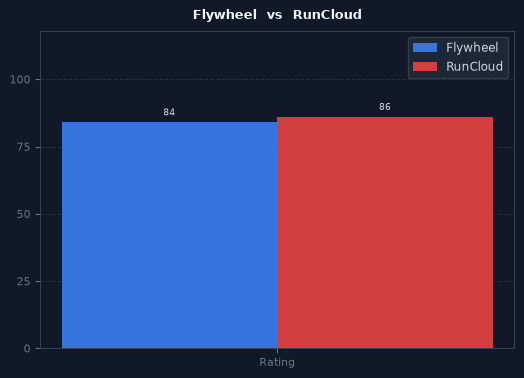
# Flywheel vs RunCloud Analysis Flywheel and RunCloud represent distinct approaches to managed WordPress hosting. Flywheel's primary advantage lies in its transparent, fixed pricing structure at $15/month, making it ideal for budget-conscious users seeking predictable costs and simplified decision-making. RunCloud's custom pricing model, while less immediately accessible, allows flexibility for enterprise-level deployments with varying resource requirements. Rating-wise, both providers perform comparably (4.2 vs 4.3), indicating similar customer satisfaction. However, RunCloud's marginally higher score reflects its capacity to serve diverse hosting needs through customizable solutions. RunCloud emerges as the overall winner for users requiring scalability and tailored infrastructure, whereas Flywheel better suits beginners and small businesses prioritizing straightforward, affordable hosting without configuration complexity. The choice ultimately depends on whether simplicity or customization takes precedence.
RunCloud edges ahead overall (4.3/5 vs 4.2/5). Choose RunCloud for better overall value; consider Flywheel if its specific feature set matters most.
We compared Flywheel and RunCloud on pricing, country coverage, IP types, supported protocols, and trial availability. Both providers target similar use cases but differ in network scale, pricing model, and platform depth. Here is everything you need to make the right choice.
Our Verdict
Based on our analysis, RunCloud edges ahead with a rating of 4.3/5 — making it the better choice for most use cases.
Feature Comparison
| Feature | Flywheel | RunCloud |
|---|---|---|
| Rating | 4.2/5 ★★★★ | 4.3/5 ★★★★ |
| Price from | $15.0/month | Custom |
| Types | sharedprofessionalbusiness | startupbusinessenterprise |
| Protocols | Shared HostingProfessionalBusiness | — |
| Free trial | No | ✓ Yes |
About the Providers
Flywheel is a managed WordPress hosting platform designed specifically for web professionals and agencies. It provides pre-configured WordPress environments, automated backups, staging sites, and collaboration tools. The service emphasizes ease of use and support for designers, developers, and small businesses managing client websites.
RunCloud is a PHP cloud server management panel that simplifies VPS and server hosting for developers and hosting companies. It provides automated server setup, performance optimization, and management tools for applications ranging from early-stage startups to enterprise deployments.
Performance Comparison
Note that performance benchmarks vary significantly based on target website, geographic routing, and time of day. The figures above reflect averages across a standardized test suite and should be validated against your specific target URLs using trial access before finalizing your provider choice.
Pricing Comparison & Value Analysis
Flywheel offers three main tiers. Shared Hosting starts at approximately $15/month (billed annually around $180), suitable for single sites with basic needs. Professional plans begin around $30/month, adding priority support and higher resource allocation. Business plans start near $50/month with advanced features like white-label options, enhanced staging, and greater scalability. All plans include backups, staging, SSL, and CDN.
Specific pricing tiers are not detailed in the provided page content. RunCloud advertises transparent and simple pricing aimed at startups through enterprise clients, but exact plan names, pricing amounts, and included features require visiting the full pricing page. The platform typically offers tiered plans with varying server management capabilities and resource allowances.
Pricing model differences matter as much as headline numbers. Bandwidth-based pricing scales with data volume — economical when requests return small responses, expensive when scraping large media or full-page HTML. Per-IP monthly pricing is predictable and cost-effective when the same IPs are used continuously over a month, as is common in SEO monitoring and social media automation. Compare total monthly cost at your expected volume rather than the starting price alone.
When evaluating long-term value, also consider the cost of failures. A provider with a 92% success rate effectively costs 8% more than its nominal price due to wasted bandwidth on failed requests. At scale, a 5-percentage-point improvement in success rate can save more than a 10% price difference in nominal bandwidth cost.
Use Case Analysis — Which Fits Your Workflow?
The right hosting provider provider for your use case depends on factors beyond headline specifications. Consider the following dimensions when choosing between Flywheel and RunCloud:
Target site sophistication: If your target sites use advanced bot detection (Cloudflare Enterprise, DataDome, PerimeterX), you need residential proxies with high pool diversity and strong success rates. Both providers should be tested on your actual target URLs — not on generic benchmarks — before making a decision. Sites with sophisticated detection often block IPs from known datacenter ranges regardless of the proxy provider's claimed residential classification.
Geographic requirements: Check each provider's specific country coverage against your target markets, including whether city-level or ASN-level targeting is available for your most critical geographies.
Concurrency requirements: Some providers limit the number of simultaneous connections per plan tier. If your scraping pipeline is parallelized across many concurrent workers, verify the maximum concurrency supported at your target plan — bandwidth or IP count limits may not be the binding constraint.
Declared use case fit: Flywheel is designed for small business, freelancer, developer, business. RunCloud targets developer, business, small business, enterprise. If your use case maps more directly to one provider's declared focus, that provider has likely optimized its infrastructure and support documentation for your workflow.
Frequently Asked Questions
Which Should You Choose?
RunCloud is the stronger overall pick in this comparison, rated 4.3/5. It performs best if you need startup and business and enterprise proxies. Flywheel is the better fit if its specific feature set is a closer match to your workload. Still comparing? The full table covers all VPS and server hosting providers with filtering by type, price, and country.